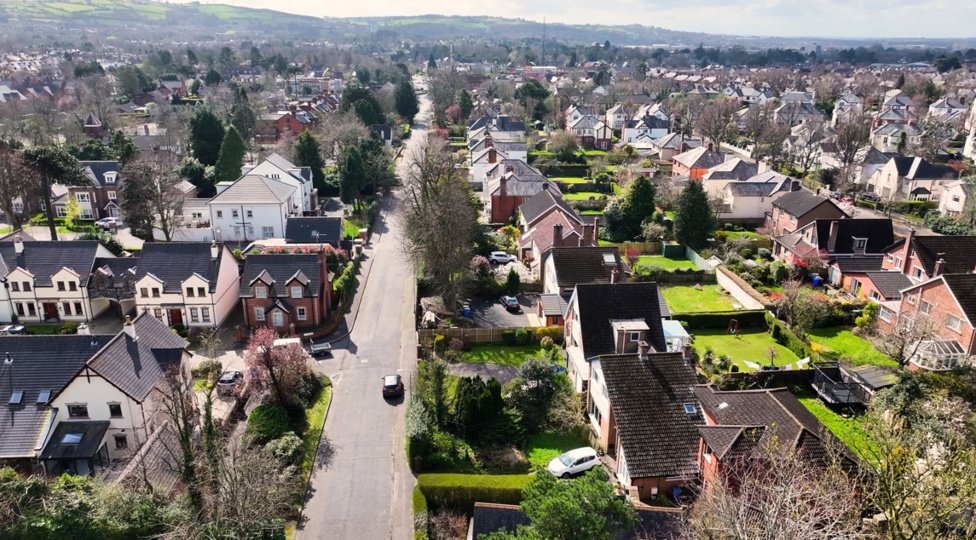
The average house price in Northern Ireland has climbed above £200,000 for the first time since the property crash of 2007-08, according to official figures released this week. It is a symbolic threshold as much as an economic one: it confirms that a housing market which suffered the most severe correction anywhere in the UK — prices fell by more than 50% peak-to-trough in some areas — has finally clawed its way back to nominal parity with its pre-crisis high, some 15 years after the bubble burst.
For UK property investors, the significance of this milestone extends well beyond Belfast's city limits. Northern Ireland has spent a decade and a half as the forgotten corner of the UK housing market, overlooked by mainland capital while London, the South East and regional English cities rode successive growth cycles. That the region has only now returned to its previous peak, while UK average prices sit roughly 35-40% above their 2007 levels, underlines just how deep and lasting the NI correction was. It also explains why Northern Ireland continues to post some of the strongest percentage growth rates in the UK — annual price inflation has been running at close to 6-7%, comfortably ahead of the UK-wide average of around 2-3% — because it is still catching up rather than overheating.
Context matters here. Even at £200,000-plus, Northern Ireland remains by a wide margin the most affordable housing market in the UK. Compare that with an average price approaching £290,000 across the UK as a whole, or the £520,000-plus typically commanded in Surrey and the wider South East. Manchester and Leeds now average around £240,000-£260,000, Birmingham sits close to £250,000, Liverpool remains below £200,000 in parts of its outer boroughs, and Newcastle continues to offer some of the cheapest city-centre stock in England at well under £180,000 in places. London, inevitably, operates in a different universe entirely, with averages north of £520,000. Northern Ireland's re-crossing of the £200,000 line therefore does not signal an expensive market — it signals a market finally normalising after an exceptionally long convalescence.
The drivers behind this recovery are structural as much as cyclical. Northern Ireland has benefited from persistent undersupply of new housing stock, a stable if unspectacular local economy anchored by public sector employment, and increasing cross-border interest from buyers and investors based in the Republic of Ireland, where Dublin's housing costs are now among the highest in Europe. Belfast in particular has seen renewed institutional and private landlord interest, spurred by the city's growing professional services and fintech employment base. Mortgage affordability has also played a role: with interest rates having stabilised after the sharp increases of 2022-23, buyers priced out of English regional cities have increasingly looked to Northern Ireland as a market offering both lower entry costs and demonstrably strong capital growth momentum.
For buy-to-let landlords, Northern Ireland's investment case remains compelling on fundamentals. Gross rental yields in Belfast and surrounding commuter towns have consistently outperformed the UK average, often reaching 7-8% compared with 4-5% typical in London or the South East, reflecting the favourable ratio of purchase price to achievable rent. That yield advantage, combined with continuing price appreciation, makes the region attractive to portfolio landlords and smaller investors alike, particularly those exiting higher-cost, lower-yielding markets in the South of England. First-time buyers, meanwhile, face a more mixed picture: rising prices erode some of the affordability advantage that has historically made Northern Ireland attractive to young buyers, though the region's price-to-income ratio still compares favourably with almost every English or Scottish city.
Looking ahead to the next six to twelve months, expect Northern Ireland's growth rate to moderate slightly as the base effect of recovery fades, but not to reverse. Housebuilders and developers, sensing renewed confidence, are likely to accelerate delivery in Belfast, Lisburn and Derry/Londonderry, though planning constraints and construction cost inflation will temper the pace of new supply reaching the market. Commercial investors should note the knock-on effect on the private rented sector: as house prices rise faster than wages, more households will be pushed into renting, sustaining demand for build-to-rent and multi-let investment products that remain comparatively underdeveloped in the region relative to English cities.
The passage of the £200,000 threshold is best understood not as evidence of a market becoming expensive, but as proof that Northern Ireland has finally shed the legacy of its crash. In real terms, adjusting for 15 years of inflation, prices remain well below their previous peak, meaning the region still offers genuine value relative to its own history and to comparable UK markets. Investors who recognise this distinction — between nominal recovery and real-terms opportunity — stand to benefit from a market that combines the UK's strongest yield profile with continuing, if moderating, capital growth.
Key Takeaways
- Northern Ireland's average house price has surpassed £200,000 for the first time since the 2007-08 crash, but remains roughly 35-40% cheaper than the UK average.
- Annual price growth in NI is running at 6-7%, well ahead of the UK-wide average, reflecting continued catch-up rather than overheating.
- Belfast rental yields of 7-8% remain among the highest in the UK, making the region attractive to buy-to-let landlords exiting lower-yield southern English markets.
- Expect moderating but positive price growth over the next 6-12 months, alongside increased developer activity in Belfast, Lisburn and Derry/Londonderry.