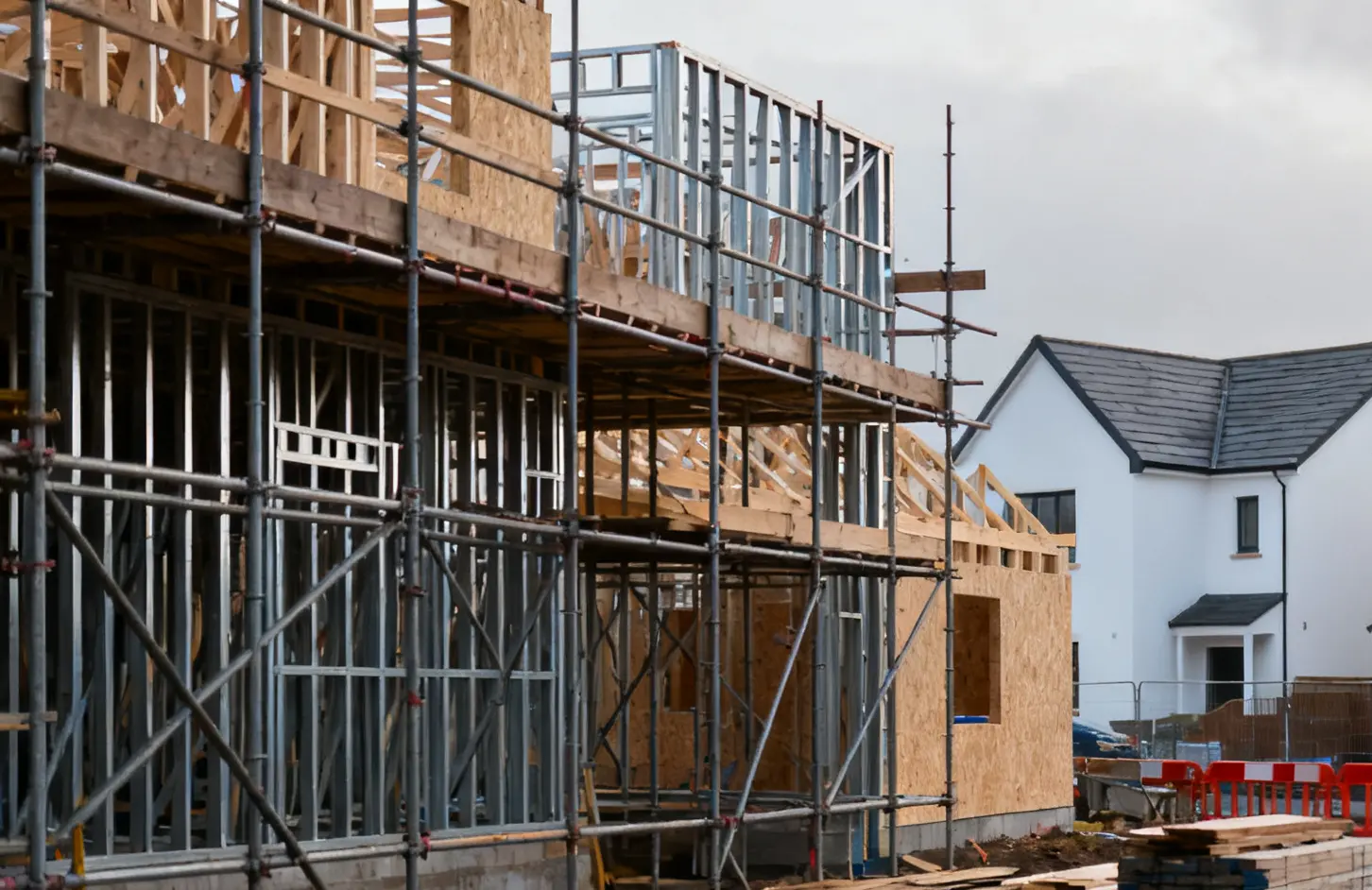
The government's ambition to deliver 1.5 million new homes over this Parliament is running headlong into a problem that planning reform alone cannot solve, according to Colliers. Andrew White, the consultancy's head of UK residential, has cautioned that streamlining planning applications and imposing mandatory local housing targets will achieve little if the underlying economics of building homes remain broken. This is a significant intervention from a firm that sits at the coalface of development advisory work, and it should give pause to ministers who have staked considerable political capital on planning reform as the primary lever for boosting supply.
For investors and developers, the distinction between planning speed and development viability is not academic - it is the difference between a scheme proceeding and one being shelved indefinitely. Build costs have risen by roughly 30-35% since 2020, driven by materials inflation, labour shortages and post-Grenfell fire safety requirements, while land values in many regions have failed to correct downward at anything like the same pace. Layer on top of this the Building Safety Levy, biodiversity net gain obligations, and increasingly onerous Section 106 and CIL demands, and the arithmetic on many sites simply no longer works. Colliers' warning effectively argues that granting permission faster for schemes that cannot stack up financially will not translate into shovels in the ground.
The regional picture illustrates why this matters so acutely. In Manchester and Birmingham, where land values have historically supported higher-density regeneration schemes, viability gaps are emerging even in prime city-centre locations as build-to-rent yields compress and construction costs remain elevated. In Leeds and Liverpool, where sales values are lower, the situation is more acute still - affordable housing quotas of 20-35% combined with rising costs mean many sites are simply unviable without grant funding or council intervention. Newcastle has seen a handful of high-profile schemes paused or renegotiated for precisely this reason. Even in wealthier commuter markets such as Surrey, where land values are robust, infrastructure contributions and biodiversity net gain requirements are squeezing margins on volume housebuilder sites to levels that no longer justify the risk relative to alternative asset classes.
London presents perhaps the starkest case study. Analysis across the capital's development pipeline has repeatedly shown that a majority of consented schemes remain unbuilt, not because of planning delay but because build costs, affordable housing requirements and elevated finance costs have eroded developer returns below the threshold at which institutional capital will commit. With gilt yields still elevated and mortgage rates sitting well above the ultra-low levels developers underwrote land purchases against during 2016-2021, refinancing existing land banks at today's cost of capital is proving painful. Colliers' point is that unless government addresses these fundamentals - through measures such as recalibrating affordable housing thresholds, providing viability flexibility, or expanding grant funding - planning reform risks becoming a paper exercise that generates permissions rather than completions.
The implications ripple across every category of market participant. Buy-to-let landlords and portfolio investors should expect continued constraint on new-build stock entering the market, which will support rental growth in undersupplied regional cities even as affordability pressures mount for tenants. First-time buyers face a similarly uncomfortable outlook: fewer completions mean sustained upward pressure on both new-build and secondhand prices in supply-constrained areas, particularly in the South East and major regional cities where demand consistently outstrips delivery. Commercial investors eyeing build-to-rent and later living schemes should scrutinise viability assumptions far more rigorously than headline planning consents suggest, since a permission is increasingly a starting point for negotiation rather than a green light for construction. Developers themselves face a bifurcated market: well-capitalised housebuilders with strong balance sheets can absorb thinner margins and wait for conditions to improve, while smaller and mid-sized developers - historically responsible for a disproportionate share of SME-led housing delivery - are being squeezed out entirely, a trend that has already seen SME housebuilder numbers fall by more than 80% since the late 1980s.
Over the next six to twelve months, expect the housing delivery debate to shift decisively from planning speed towards viability economics. Government will face growing pressure to introduce targeted interventions - whether through affordable housing threshold flexibility, expanded Help to Build-style finance for SMEs, or accelerated grant funding for stalled sites - if it wants any realistic chance of approaching its 1.5 million homes target. Absent such measures, expect completion figures to continue undershooting permissions by a wide margin, regional viability gaps to widen further, and consolidation among developers to accelerate. The uncomfortable truth Colliers has articulated is that Britain does not primarily have a planning problem; it has a cost and returns problem, and only policy that confronts that reality will move the delivery needle.
Key Takeaways
- Build costs have risen roughly 30-35% since 2020, eroding development margins even where planning consents are readily granted
- Viability gaps are widest in Leeds, Liverpool and Newcastle, where lower sales values struggle to absorb affordable housing quotas and levies
- Investors should treat planning permission as a starting point, not a guarantee of delivery, particularly for build-to-rent and SME-led schemes
- Expect continued rental growth and new-build price pressure over 12 months unless government introduces viability-specific interventions such as threshold flexibility or expanded grant funding


