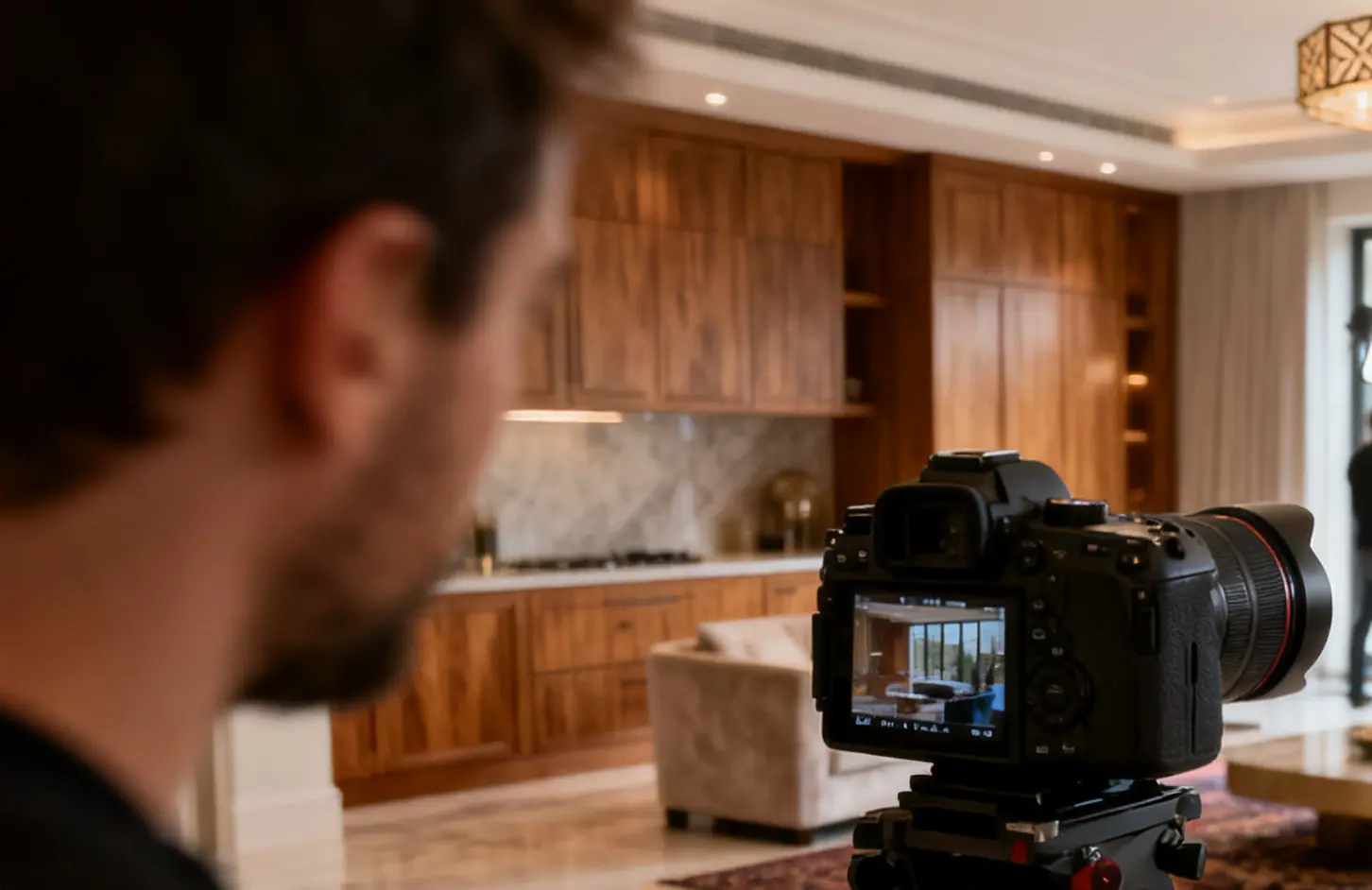
Fine & Country, the upmarket estate agency network best known for its presence in Surrey's commuter belt and other premium postcodes, has reached 200,000 subscribers on YouTube, doubling its audience in just twelve months. The channel generated more than nine million views and 74.3 million impressions in the year to July 2026 - figures that would not look out of place on a mid-sized media publisher, let alone an estate agency network. On the surface this is a marketing story. Beneath it lies a more significant shift in how UK property, particularly at the upper end of the market, is discovered, valued and sold.
For professional investors and developers, the relevant question is not whether an agency has a large social following, but what that following signals about buyer behaviour. Property search has migrated decisively online over the past decade, but the last two years have seen a further shift from static portals such as Rightmove and Zoopla towards video-first discovery, particularly among international and cash-rich buyers researching UK homes remotely. A YouTube audience of this scale suggests Fine & Country is capturing attention from precisely the demographic that drives transactions in Surrey, the Home Counties and London's prime fringes: buyers who may never set foot in a branch before making a shortlist decision based on a walkthrough video.
This matters commercially because video content converts differently to photography. Industry data consistently shows listings with video attract 40 per cent more enquiries than photo-only listings, and dwell time on video content is measured in minutes rather than seconds. For vendors instructing agents in higher-value markets - properties above £750,000, where Fine & Country's proposition is strongest - the ability to generate genuine reach beyond a local catchment area has become a differentiator when choosing representation. Agencies without a credible video and social strategy increasingly look under-resourced by comparison, particularly when competing for instructions in competitive prime markets like Surrey, Cheshire and parts of North Yorkshire.
The regional implications extend well beyond the South East. Manchester and Leeds have both seen a surge in high-value new-build apartment schemes marketed primarily through video content aimed at overseas investors, while Birmingham's regeneration zones - particularly around Digbeth and the wider HS2 corridor - increasingly rely on cinematic marketing to sell units off-plan before physical show suites are even built. Liverpool and Newcastle, both experiencing renewed institutional interest in build-to-rent stock, are following the same playbook, with agents and developers using video to reach yield-focused investors based in London, Hong Kong and the Gulf who are unlikely to view a property in person before exchange. Fine & Country's growth simply provides a measurable case study of a trend that is already reshaping how stock across the UK is marketed.
For buy-to-let landlords and smaller developers, the lesson is practical rather than abstract. Marketing spend that once went entirely into portal listings and print is increasingly better allocated towards professionally produced video content, even for standard three- and four-bedroom rental stock, since tenant and buyer expectations have shifted upward across the board. First-time buyers, too, now routinely use video tours to filter viewings before committing time to physical visits, tightening the funnel for agents and meaning that properties without strong visual content risk being filtered out before a viewing is even requested. Commercial investors evaluating agency partners for portfolio disposals should treat digital reach and engagement metrics as a genuine part of due diligence, not a vanity statistic, given the direct correlation between visibility and achieved price in competitive bidding scenarios.
Looking ahead twelve months, expect consolidation of marketing spend among agencies with proven digital reach, at the expense of smaller independents unable to match production quality or audience scale. This will likely accelerate partnership and franchise models, of the kind Fine & Country already operates, where local offices benefit from centrally produced content and national brand visibility rather than building audiences from scratch. Prime markets in Surrey and the wider South East, along with regeneration-driven markets in Manchester, Birmingham and Leeds, are best placed to benefit from this shift, given their exposure to remote and international buyers who rely disproportionately on video before committing to a transaction. Agencies and developers slow to adapt risk losing instructions not on price or service quality, but simply on visibility.
Key Takeaways
- Fine & Country's YouTube audience doubled to 200,000 subscribers in a year, generating 74.3 million impressions - evidence that video is now central to prime property marketing.
- Vendors in high-value markets such as Surrey should treat agents' digital reach as a genuine factor in instruction decisions, given its measurable link to buyer engagement and achieved price.
- Developers marketing off-plan schemes in Manchester, Birmingham, Leeds and Liverpool are increasingly reliant on video to reach overseas and remote investors before physical viewings occur.
- Buy-to-let landlords and smaller agencies should reallocate marketing budgets towards professional video content, as portal-only listings risk being filtered out by increasingly digital-first buyers and tenants.


