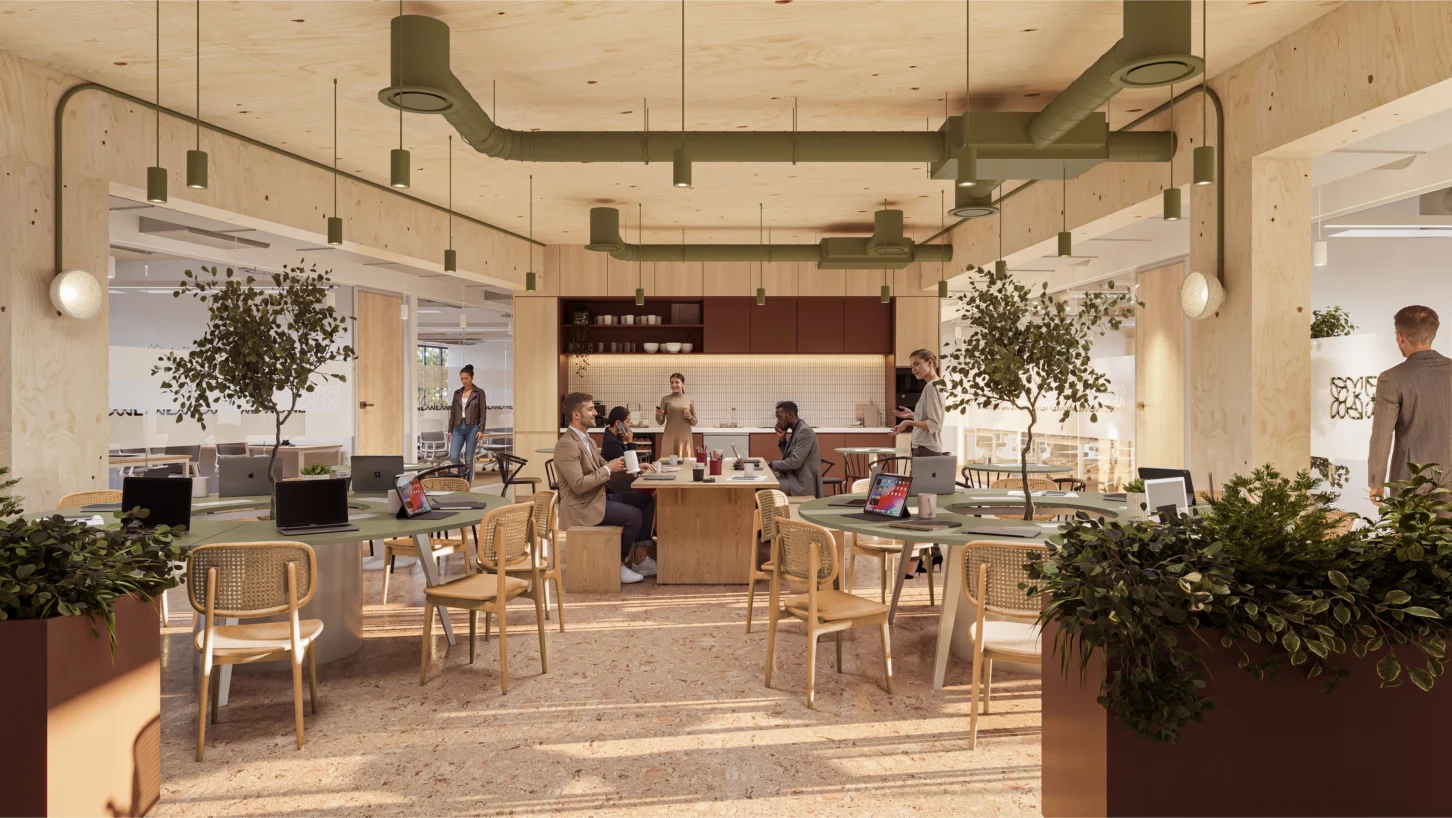
Bywater has appointed international flexible workspace operator infinitSpace to launch beyond Paradise, a premium flex offering at Paradise SE11 in Vauxhall - a development already notable as the UK's lowest embodied carbon mass timber office scheme. The partnership marks a deliberate move away from conventional long-lease models towards an operator-led approach that blends sustainability credentials with the flexibility increasingly demanded by occupiers in a post-pandemic office market. For a developer positioning itself as carbon-conscious across its UK portfolio, the decision to embed flex space at the ground floor of a flagship low-carbon asset is as much a statement of intent as a commercial calculation.
The timing matters. London's office market has bifurcated sharply over the past 18 months, with prime, ESG-compliant space commanding rental premiums of 15-20% over secondary stock, according to several agency reports circulating through 2024. Vacancy rates for grade A sustainable buildings in central London have held below 8%, while poorer-quality secondary space languishes at vacancy levels closer to 20% in some submarkets. Vauxhall, long overshadowed by Nine Elms' residential-led regeneration, is increasingly positioned as a commercial node benefiting from Northern line connectivity and proximity to Westminster - making it a plausible test bed for premium flex demand that might previously have gravitated exclusively to Shoreditch, King's Cross or the West End.
For commercial property investors, this deal illustrates a broader repricing of risk around office assets. Institutional capital has grown wary of single-let, long-lease office investments given hybrid working's persistent drag on occupancy, but operator-led flexible space - particularly when paired with strong sustainability data - is attracting renewed interest from funds seeking income resilience. infinitSpace's involvement brings operational expertise that Bywater, fundamentally a developer and investment manager, would otherwise lack. This division of labour - developer builds low-carbon assets, specialist operator monetises the space - is becoming a template replicated from Manchester's NOMA district to Birmingham's Paradise Circus (a naming coincidence worth noting), where developers increasingly outsource workspace operations rather than run them in-house.
The embodied carbon angle deserves particular scrutiny. Mass timber construction, whilst still a minority technique in UK commercial development, is gaining traction as occupiers - especially financial services and professional firms with net-zero commitments - actively seek office space that reduces their scope 3 emissions exposure. Paradise SE11's claim to the lowest embodied carbon mass timber office in the UK gives Bywater a genuine point of differentiation in a market where ESG credentials are shifting from marketing gloss to leasing prerequisite. Corporate occupiers in Leeds and Newcastle, where flexible workspace demand has grown but low-carbon stock remains scarce, will be watching whether London's premium flex-plus-sustainability model proves commercially viable before similar schemes emerge in regional cities.
The implications extend beyond commercial investors to the wider property ecosystem. Developers weighing whether to pursue mass timber or other low-carbon construction methods now have a concrete commercial proof point to reference, potentially accelerating adoption across secondary UK cities where planning authorities are tightening embodied carbon requirements - Greater London Authority policy already pushes towards whole-life carbon assessments, and other authorities are expected to follow. For buy-to-let landlords and residential investors, the read-across is more oblique but still relevant: Vauxhall's evolution as a mixed-use, amenity-rich district supports residential values in Nine Elms and south Lambeth, reinforcing the thesis that commercial regeneration and residential capital growth are increasingly intertwined in London's outer-core submarkets.
Looking ahead six to twelve months, expect flexible workspace operators to become standard partners on new-build low-carbon office developments rather than an afterthought bolted onto existing stock. Landlords holding older office assets without a credible decarbonisation pathway face growing obsolescence risk, particularly as lenders and insurers tighten underwriting criteria around energy performance certificates and embodied carbon disclosure. The Bywater-infinitSpace tie-up should be read not as an isolated leasing deal but as an early signal of how premium UK office development will be structured going forward: carbon performance as the foundation, operator partnerships as the delivery mechanism, and flexibility as the non-negotiable occupier demand. Developers slow to adopt this template risk ceding ground to those, like Bywater, already moving decisively.


